
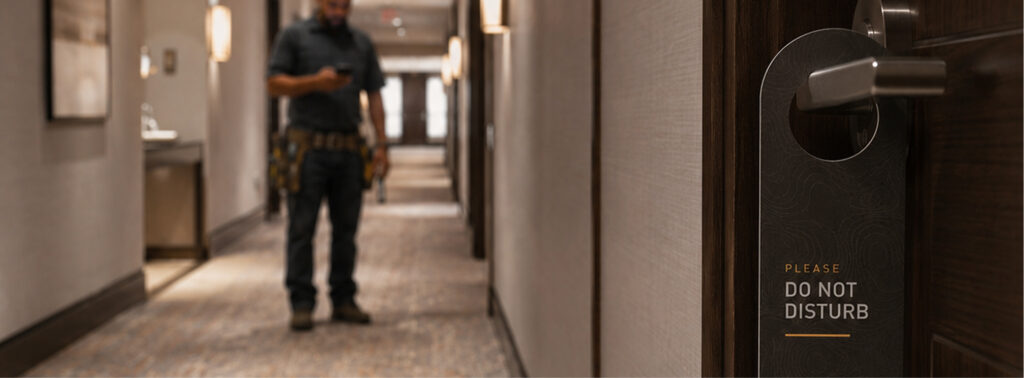
Most hotels have a DND policy written down somewhere. The problem is what happens between the paper and the floor.
A housekeeper notes the sign at 9 a.m. She notes it again at 2 p.m. She tells her supervisor at the end of her shift. The supervisor leaves a note for the front desk. By the time anyone makes a phone call, it is the next morning and 28 hours have passed. That gap is not a training failure. It is a systems failure. And it is happening in hotels everywhere, every day.
What should a hotel do when a Do Not Disturb sign has been up for more than 24 hours?
Most major hotel brands require a welfare check after 24 to 48 hours of continuous DND status. Staff should log the start time, attempt phone contact, and escalate to management if no response is received. The key is defining a consistent threshold in writing so every shift enforces it the same way.
It Is More Than a Privacy Request
The "Do Not Disturb" sign used to be a simple housekeeping instruction. Today it carries operational, legal, and security weight that most small and mid-size hotels are not fully prepared to manage.
Hotels carry a legal duty of care to their guests. That obligation does not pause because a sign is on the door. Hotels are required to take reasonable steps to identify and mitigate potential hazards and respond promptly to any incidents that may occur. An extended DND status that goes untracked and unescalated can become evidence of negligence if something goes wrong inside that room.
In the wake of the 2017 Las Vegas shooting, in which a hotel guest prevented staff from seeing weapons by displaying a "do not disturb" sign, many hotels and brands began eliminating these signs or overhauling their privacy policies. That event shifted how the entire industry thinks about DND. What was once treated as a guest preference became a recognized security gap.
What the Industry Now Expects
MGM Resorts follows a welfare check procedure that requires a check after two consecutive days where a Do Not Disturb sign has been displayed and the guest has not interacted with housekeeping or other hotel staff over the same period. Hilton, Caesars, and Disney have all updated their policies in similar ways, with check thresholds ranging from 24 to 48 hours depending on the property.
The AHLA and the Department of Homeland Security both flag extended DND usage as a potential indicator of illicit activity, including human trafficking. When a room refuses service for multiple days, requests excessive linens without allowing entry, or shows unusual foot traffic, it is no longer a housekeeping note. It is an escalation trigger.
The question is not whether your hotel should have a policy. You almost certainly do already. The question is whether your team can execute it consistently, on every shift, without dropping the ball in the handoff between housekeeping and the front desk.
Where the Breakdown Actually Happens
Most DND failures are not about intent. Staff know the sign matters. The breakdown happens in three places.
- No Consistent Threshold Without a defined trigger point, 24 hours means something different to every housekeeper on the floor. One flags it. Another assumes a colleague already did. Another waits for the supervisor to ask.
- Manual Logging Creates Gaps When DND persists for extended periods, housekeeping is expected to log the time and date of each attempt to service the room. On paper, in a shared binder, passed between shifts. That log depends entirely on every person in the chain doing their part. In a hotel running lean on staff, it breaks.
- Front Desk and Housekeeping Are Not in Sync The housekeeper sees the sign. The front desk has no visibility into how long it has been there. The duty manager only learns about it when someone remembers to tell them. In standard SOP, a room can go 36 to 48 hours before the right person even knows about it.
What a Practical DND Protocol Looks Like
Before you can automate anything, you need a written SOP your team can actually follow. Here is what a solid one covers.
Define the threshold clearly.
Set a hard time: 24 hours for standard stays, 12 hours for any room showing other flags such as repeated linen requests, unusual traffic, or a no-contact checkout date approaching. Everyone on every shift works from the same number.
Assign ownership by role.
The housekeeper logs the DND start time. The floor supervisor reviews the DND list at mid-shift. The front desk is notified when a room crosses the threshold. The duty manager takes any escalation from there. No one person carries the whole chain.
Create a low-friction way to flag concerns.
Staff should never have to decide in the moment whether something is serious enough to report. Give them a simple, non-confrontational way to surface a concern without approaching the room themselves. This protects staff and keeps the escalation in management hands where it belongs.
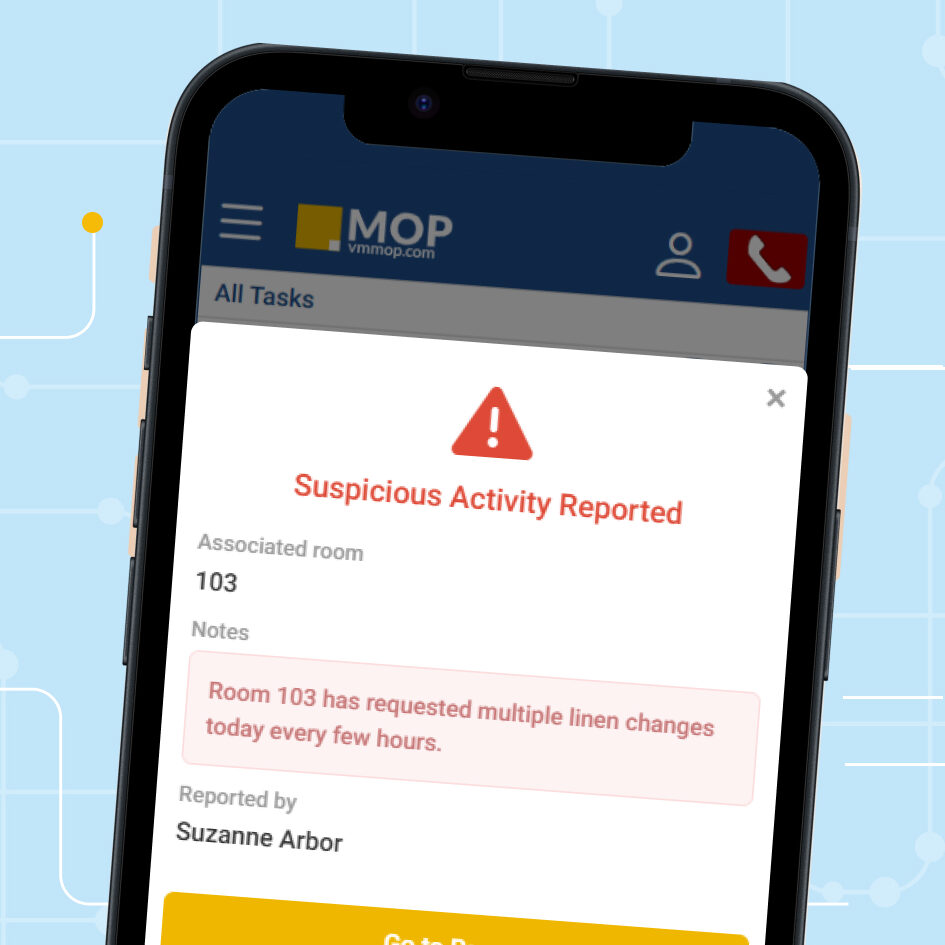
MOP's On-Property Alerts includes a built-in Suspicious Activity feature that lets staff report concerns instantly and discreetly from their phone. No confrontation. No guessing. The right people are notified the moment something is flagged.
See On-Property Alerts in action →Document every attempt.
Phone call made at what time. Note left under door at what time. Duty manager notified at what time. If a situation later becomes a legal or law enforcement matter, that log is your protection.
Train staff on what to look for, not just what to do.
Extended DND is one signal. Requests for extra towels and linens with no room access is another. Frequent external visitors at odd hours is another. Staff do not need to make judgments. They need to know which observations to pass up the chain.
How MOP Closes the Gap
The steps above are sound. The problem is that executing them consistently across every shift, with staff turnover rates that the hospitality industry averaged above 5% per month in 2024, is nearly impossible to do manually.
MOP by Visual Matrix builds the DND escalation process directly into the housekeeping workflow so it does not depend on anyone remembering.
- Automated Threshold Flagging MOP tracks DND status in real time and flags rooms that cross your defined threshold automatically. Housekeeping management sees it on their device without waiting for a paper log to surface.
- Cross-Department Visibility The front desk and housekeeping see the same status at the same time. When a room hits the threshold, the right people know immediately. The information does not sit in one department waiting to be passed to another.
- On-Property Alerts for Discreet Reporting When a housekeeper notices a concern tied to a DND room, she can report it through MOP's On-Property Alerts without approaching the room or making a judgment call. The alert goes to management. The response stays in the right hands.
- A Log That Builds Itself Every flag, every notification, every escalation is time-stamped and recorded. When you need to demonstrate that your team followed protocol, the documentation is already done.
The result is a safety policy that runs the same way on a Tuesday morning and a Saturday night, with a new hire and a ten-year veteran, whether the supervisor is on property or not.
Awareness without action creates exposure. The right tools make action automatic.
Ready to turn your safety policies into practice? Discover how MOP's On-Property Alerts can help your team respond safely and consistently.
See How MOP Handles DNDs →