
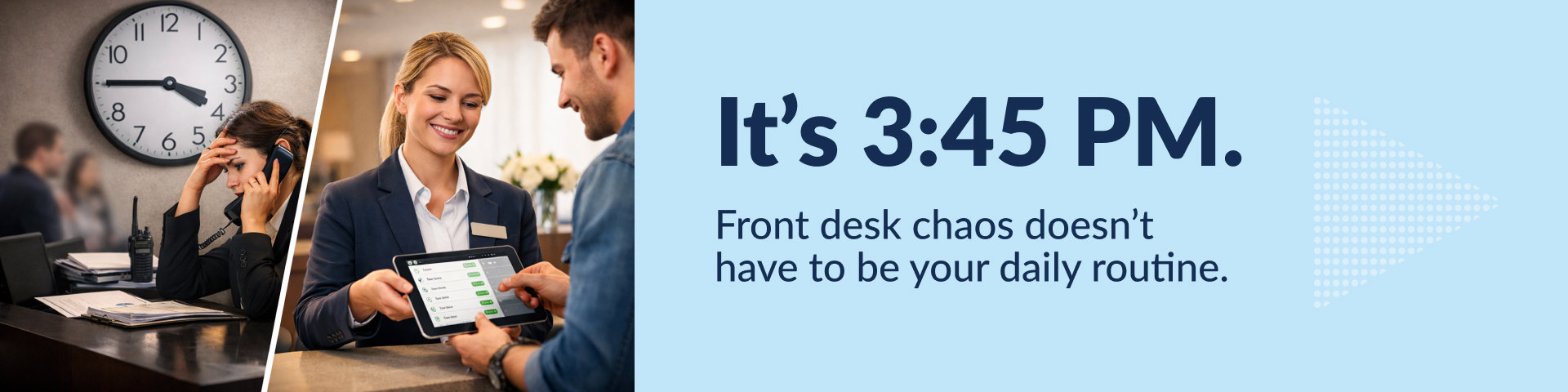
The 3:45 PM rush is not a housekeeping problem. It is a sequencing and communication problem. Your team is fast enough. The system around them is what slows them down.
Here are five habits that high-performing housekeeping operations run on, and how automated room status makes each one stronger.
1. Prioritize Cleans Efficiently
Most teams chase departures first because they feel urgent. The problem is that departures keep trickling in all day, which creates idle time and ragged check-in flow.
The order that actually works:
When room status updates automatically for housekeeping teams to see, they can see the “already checked out” pile fill up live rather than knocking on doors to see who has left.
2. Use Discrepancy Reports as a Coaching Tool, Not a Chore
On the busy days, discrepancy reports can feel like a housekeeping nuisance. The real value is pattern recognition.
Run the report weekly with your supervisor and look for three things: repeat rooms, repeat housekeepers, and repeat days of the week. If room 412 shows discrepancies three weeks in a row, you have either a process gap, a guest doing something unusual, or a maintenance issue someone keeps missing. Any of those is worth a conversation.
Automated status makes this report dramatically more accurate because the timestamp on every status change is captured automatically, not written down at the end of a shift.
3. The Two Minute Maintenance Rule
Train housekeeping to log a maintenance issue the moment they see it, not at the end of the clean. A burned out bulb logged at 9 AM gets fixed before the next guest checks in. The same bulb logged at 4 PM rolls into the next shift, and the room turns dirty again.
The accelerator here is photo logging. A photo eliminates the back and forth of “which lamp” or “which lightbulb.” Maintenance shows up knowing exactly what they need.
This is the kind of habit that only works if logging is faster than ignoring. On paper or by radio, ignoring wins. On a phone, logging wins.
4. Reset Your “Ready By” Target from 3 PM to 2 PM
Industry standard check-in is 3 PM, but most guests arrive between 2 and 5. If your team is racing to hit 3 PM, you are already behind on the day’s actual demand.
Move the internal goal to 2 PM for 80 percent of departures. That one hour buffer is what keeps the lobby quiet, gives the front desk room to handle early arrivals as a goodwill win, and creates margin for the inevitable difficult room.
You cannot manage to a 2 PM target without real-time visibility into where the team is at 11 AM, noon, and 1 PM. That is the part automation unlocks.
5. Cross-Train the Departments to Inspect Rooms
The fastest way to eliminate the 3:45 PM bottleneck is to add inspectors when you need them most. Train your front desk agents to inspect rooms.
This solves two problems at once. First, when housekeeping is buried at peak turn, a front desk agent can clear inspected rooms instead of waiting for the supervisor to walk them. Second, agents who have actually inspected a room understand what “clean and inspected” really means. They stop sending guests to rooms that are not ready, stop blocking rooms unnecessarily, and stop calling housekeeping to ask what the screen already shows.
Run a 90 minute joint training between housekeeping and front desk once a quarter. Walk a few rooms together. Let the agents see what the supervisor checks for and why. Refresh it for every new hire.
Cross-trained teams move faster because the work is no longer siloed. Housekeeping cleans, anyone qualified inspects, the front desk assigns. The handoff disappears.
What Automation Actually Changes
None of these habits require new software to start. You can run the cleaning order tomorrow. You can pull the discrepancy report this week. You can train the front desk next month.
What automation does is amplify each one. Real-time status means the supervisor sees the team’s progress without radio calls. Photo-based maintenance logging means issues get fixed before they cost a turn. Accurate timestamps mean the discrepancy report tells the truth. And the front desk stops interrupting housekeeping every fifteen minutes because the screen already has the answer.
The 3:45 PM rush gets quieter. The team gets the time back. And guests notice.
Streamline your room status updates and eliminate the 3:45 PM bottleneck.
Hospitality Software Built for the Way Hotels Actually Operate
More than 3,000 properties in 40+ countries worldwide choose the Visual Matrix hospitality operating platform to optimize hotel operations and serve guests from reservation to return stay. Our system includes a game-changing PMS supported by powerful features and key integrations that are easy to use, including revenue management with automated rate tiering, a fully integrated channel manager, and a mobile app for tracking performance on the go. The Visual Matrix MOP housekeeping and maintenance tool automates routine tasks and streamlines communication to keep the front desk, housekeeping, and maintenance staff focused on guests It also includes a built-in panic button as an Emergency Safety Device (ESD) to help keep hotel staff from harm. For more information, visit visualmatrix.com.